
Since the last update, we’ve detailed the first version of our concepts interaction and technical design. As shown in the GIF above, the interaction with the rain stick consists of a few states. These states are dictated by a gyroscope sensor that is housed inside the rainstick and communicates via WiFi to a processing sketch. The pattern and colour in the sketch is mapped to the pitch and roll of the gyroscope, and the colour of the LED’s are mapped to the processing sketch.

The concept consists of a canvas (made of a net of LED’s), and a controller (a rainstick). These are detailed in the images below.

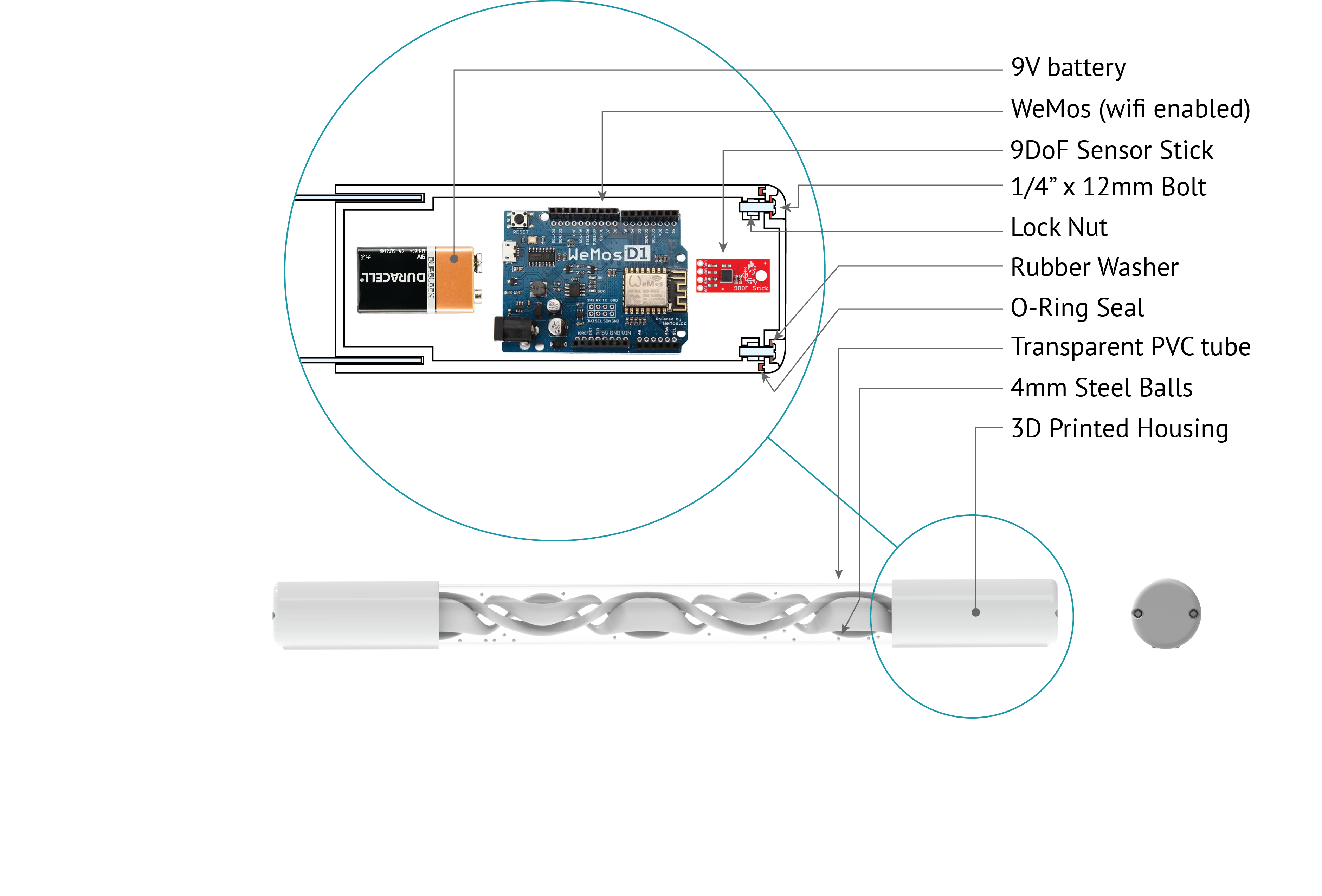
Our design challenge is to create a moment of escape to students studying inside the Masters Homebase, and this is achieved in the design by engaging them with the spontaneous play facilitated by the installation. Through experimental interaction, users will discover how to control the lighting effects along the Hex Box structure whilst enjoying the calming sound of rain simulated by the rainstick.
Some Challenges and Changes
Naturally, this process has highlighted some challenges.
| Challenge | Solution |
| The quote for the 3D printed housing in the rainstick was over $900. It is clear that we need to consider other ways of making the rainstick, and unfortunately it means saying goodbye to the transparency of the tube. | A post tube is the exact same size, and only costs $4. Similarly, the internal structure can be made from wire and the 3D printed housing that is required to fix the gyroscope sensor in a level position can be smaller and therefore more affordable. |
| The time required to build a net of LED’s from cut and rewired LED strips is intense. In addition to this, we planned to make them waterproof and to achieve this would require assembling the LED’s with heat shrink and sealant. | Our tutor, Ruchi, came to the rescue by recommending an off-shelf LED strand product produced by Adafruit that houses spaced out LED’s in a waterproof system. These strips will save us days of work. Follow this link to see what we’re talking about: https://www.adafruit.com/product/3631 |
| The system of code between the two WeMos boards and processing is quite complicated and means that we need to have a laptop on site the whole time. This is not impossible, but it certainly adds a layer of complexity to the installation. | After reviewing the design we discussed the possibility of removing the processing sketch from the system. This is something that we will be working on and considering in detail over the coming week. |
Next Steps
Our timeline from here is tight and clear. This coming week we are confirming the code system and applying it to the new LED strand so that we can conduct a desktop review. We are also locking down the design of the rainstick, now more affordable, and purchasing any required components in preparation for week 11 where we build and test the design.

 idea9202studio2019